

NCAA Academic Eligibility Explained in Plain English | CDA
If NCAA academic eligibility feels confusing, you are not alone.
Most families do not realize how important it is until someone mentions eligibility and suddenly everything feels urgent.
Let's slow this down and talk about it in plain English.
What NCAA Eligibility Really Comes Down To
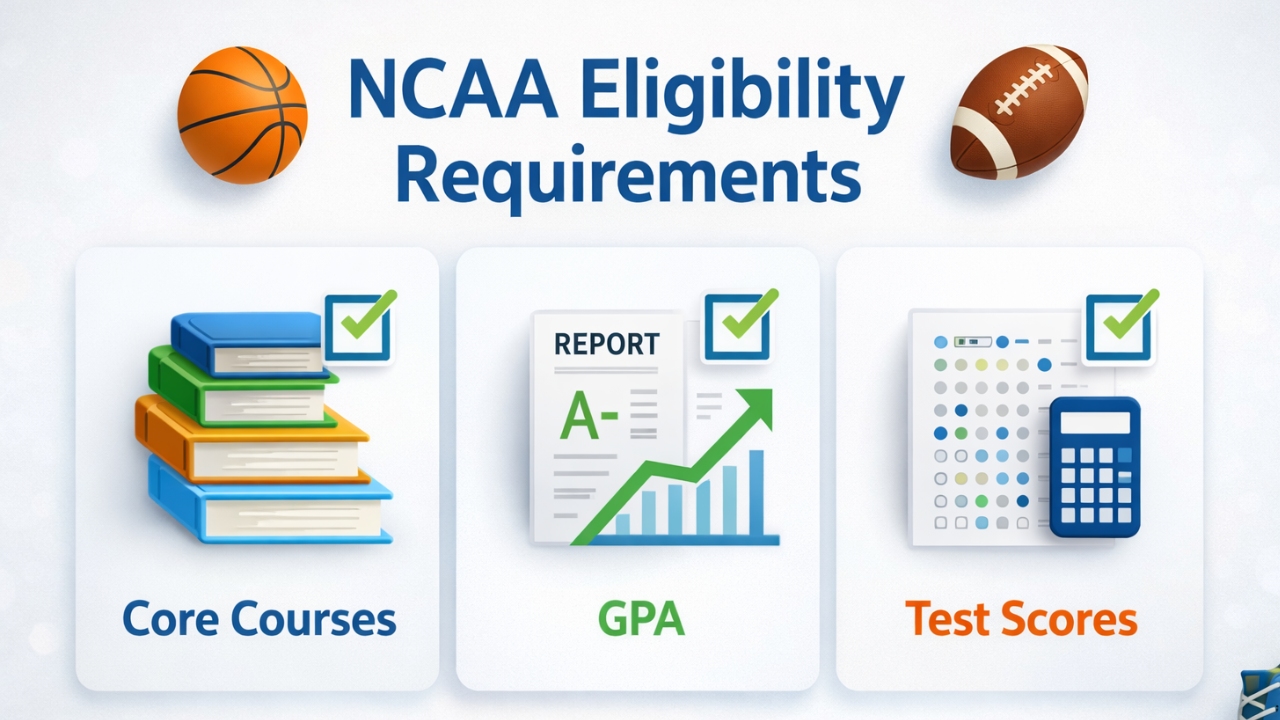
At its core, NCAA academic eligibility is about three things:
Core courses
GPA
Test scores
That's it.
The confusion usually comes from not knowing how these pieces fit together or when to start paying attention.
The NCAA is really tough to figure out... eligibility to play sports on an NCAA team. You hear so much technical jargon – sliding scales, exceptions – and it's super overwhelming. But once you get past all that jargon, there really isn't anything complicated about it.
You only need 3 things in order to be eligible to play NCAA sports:
(1) Take the right classes, (2) Have the right grades in those classes, and (3) Have the right test scores compared to your GPA so that your GPA meets the NCAA minimum requirement for eligibility.
If you can understand all of these 3 components and how they work together, then you won't feel overwhelmed by the NCAA process.
Core Courses Matter More Than You Think
Not every class counts toward eligibility. The NCAA requires specific core courses in areas like math, English, science, and social studies.
One of the most common mistakes families make is assuming everything on a transcript counts. It doesn't.
Families often do not know what trumps them up. A student may have a great overall GPA; if they do not have enough NCAA-approved core classes or are not doing well in these classes, then it won’t matter how good their GPA is; they will not be eligible.
This is particularly tricky when not every high school can adequately denote what is NCAA-approved versus what isn’t. There can be elective classes offered that may appear to be academic – they may not count as an NCAA-approved core class. Other classes that carry an advanced or “Honors” designation do not count either if the school did not submit these classes correctly to the NCAA.
Last but not least, you cannot just wait until your senior year and take core classes to “catch up.” There are limitations on how many core classes you can take after specific grade levels, as well as how many classes you must have completed by certain dates.
This is why understanding NCAA core courses early, ideally by freshman year, is so critical. Waiting until junior or senior year to figure this out can leave families scrambling with very few options.
The good news? Your athlete's high school guidance counselor should have a list of NCAA approved core courses. If they don't, you can check the NCAA Eligibility Center website. Get that list early and plan accordingly.
Timing Is Everything

Eligibility issues usually don't come from one bad grade. They come from waiting too long to check in.
By the time senior year rolls around, options are much more limited.
This is why early planning matters.
This is a situation that occurs consistently. Families often believe their child will automatically be eligible, simply because he or she is passing courses plus performing well in the sport. Then in the junior year, someone mentions the NCAA Eligibility Center, and parents say, "We don't know whether our child is on track or not"
Suddenly, the family is running around before school starts trying to determine if enough core courses were completed, GPAs are high enough, and what test scores may be required. The family could have avoided this panic entirely by putting some kind of plan in place in the freshman or sophomore years!
Starting early gives families room to adjust. If your athlete's core GPA is a little low after freshman year, there's time to bring it up. If they're missing a required science course, there's time to fit it into the schedule. If test scores are needed, there's time to prep and retake if necessary.
Waiting until senior year? That's when families hear phrases like "it's too late" or "your only option is." And no one wants to be in that position.
Common Eligibility Mistakes
Assuming eligibility will sort itself out
Not tracking core courses
Waiting until junior or senior year to ask questions
None of these mean an athlete is doomed. They just mean things got overlooked.
The biggest mistake is assuming someone else is handling it. Guidance counselors are overworked and manage hundreds of students. Coaches are focused on training and competition. Unless a parent or the athlete themselves is actively tracking eligibility requirements, things slip through the cracks.
One common oversight made by recruits is to register with the NCAA Eligibility Center and not have their transcripts sent in time to receive their initial eligibility determination. Too often, recruits wait until the last minute to start creating their account and sending in transcripts resulting in a delay in certification and creating additional stress on an already chaotic senior year.
Here's something else that catches many families unaware. The different divisions (I, II and III) each have their own eligibility rules. A rule that applies to one division may not apply to another. If your athlete is being recruited by colleges from multiple divisions, it is critical that you understand the eligibility requirements applicable to the division of the recruiting institution.
Parent Reassurance
If you're reading this and feeling nervous, take a breath.
Eligibility issues are very often fixable when caught early enough. Panic doesn't help. Information does.
We've worked with families who discovered eligibility gaps with plenty of time to fix them. Maybe the athlete needed to retake a core course over the summer. Maybe they needed to adjust their course load for senior year. Maybe they needed to focus on bringing up their test scores.
All of that is manageable when there's time. The key is not letting fear or confusion keep you from getting the information you need.
If you're unsure where your athlete stands, start asking questions now. Check their transcript against the NCAA core course requirements. Calculate their core GPA. Look into whether test scores will be required based on their GPA.
Knowledge is power here.
Our Approach
At Carpe Diem Academics, we help families stay ahead of eligibility requirements so nothing becomes a last minute crisis.
When you understand the rules and have a plan, eligibility stops feeling scary and starts feeling manageable.
We guide families through the complete journey from finding appropriate classes to tracking progress to maintain eligibility so that nothing slips between the cracks. We eliminate the confusion of NCAA GPA requirements and eligibility rules that athletes must follow. We also provide athletes with the necessary structure to create a clear timeline of when things are due and when they will be completed.
The reality is that eligibility is easy to understand once you understand it. It is very easy to miss if you don’t have an understanding of what to look for.
Eligibility feels overwhelming until you actually understand it. We help families stay ahead of it instead of scrambling later.